Cash Collections: Formula, Examples and How to Speed Them Up

All articles
Cash collections are the payments a business actually receives from its customers in a period, mostly customers settling invoices for sales made on credit. You calculate them from your accounts receivable (the money customers owe you):
Cash collections = opening accounts receivable + credit sales − closing accounts receivable
For example, if customers owed you £18,000 at the start of the quarter, you made £60,000 of credit sales and they owed £22,000 at the end, you collected £18,000 + £60,000 − £22,000 = £56,000.
Collecting cash quickly matters because profit only becomes useful once it is in the bank. A business can be profitable on paper and still run out of cash if customers pay late. Good collection keeps your liquidity and financial health strong.
Manage your cash flow in Brixx
Get started with our forecasting software so that you can plan your business' future
Start your free trialCash collections formula
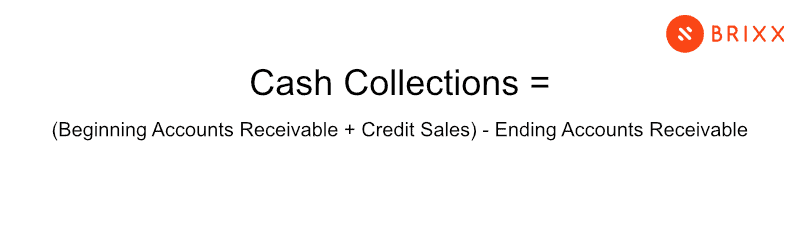
- Opening accounts receivable: what customers owed you at the start of the period.
- Credit sales: sales invoiced during the period that were not paid on the spot.
- Closing accounts receivable: what customers still owed at the end of the period.
The logic is simple. Everything customers could have paid you is what they already owed plus what you invoiced. Whatever is still unpaid at the end is what they did not pay. The difference is what you collected.
If you also take payment at the till or online at the point of sale, add those cash sales to get the total cash received from customers:
Cash received from customers = cash sales + cash collections
Worked example: calculating cash collections from accounts receivable
A small design agency invoices all its work on 30-day terms. For the quarter from January to March:
| Accounts receivable on 1 January | £18,000 |
| Plus credit sales invoiced in the quarter | £60,000 |
| Total that could have been collected | £78,000 |
| Less accounts receivable on 31 March | £22,000 |
| Cash collections for the quarter | £56,000 |
The agency collected £56,000, but its receivables grew by £4,000. Customers paid less than it invoiced, which is a sign that payments are slowing. Tracking debtor days alongside cash collections shows whether that is a one-off or a trend.
Cash collections schedule: forecasting when cash will arrive
A cash collections schedule (sometimes called a cash collections budget) turns your sales forecast into the cash you expect each month, based on how quickly customers usually pay. It is one of the main inputs to a cash budget.
Suppose a wholesaler’s customers typically pay like this: 30% in the month of sale, 60% the following month, 8% the month after, and 2% never pay. With sales of £40,000 in January, £50,000 in February and £45,000 in March, March collections are:
| Sales month | Sales | Share collected in March | Collected in March |
|---|---|---|---|
| March | £45,000 | 30% | £13,500 |
| February | £50,000 | 60% | £30,000 |
| January | £40,000 | 8% | £3,200 |
| Total cash collected in March | £46,700 | ||
March sales were £45,000 but March cash was £46,700, because it includes money still coming in from earlier months. That timing gap is exactly why a cash flow forecast can look very different from the profit and loss. The 2% that is never paid should be planned for as doubtful debt.

What happens in the accounts when you collect cash?
Collecting cash from a customer does not create new income. The sale was already recorded when you raised the invoice. Collection simply swaps one asset for another: the journal entry is a debit to your bank account and a credit to accounts receivable.
| Account | Debit | Credit |
|---|---|---|
| Bank | £1,200 | |
| Accounts receivable | £1,200 |
Your profit does not change, but your cash does. That is why cash collection shows up in the cash flow statement, not the profit and loss. See how accounts payable and receivable interact with cash flow.
Methods of cash collection
Most businesses use several of these, depending on who their customers are:
- Bank transfer, including Faster Payments in the UK, the most common method for invoices.
- Direct Debit, which lets you collect recurring or agreed payments automatically on the due date.
- Card payments, in person or online, usually settled to your account within a few days.
- Online payment platforms such as PayPal, Stripe or GoCardless, often linked to your invoices.
- Cash and cheques, still common in some sectors but slower to bank and reconcile.
- Instalment plans, which spread a large payment over time.
- Collection agencies, a last resort for debts that are seriously overdue.

The cash collection process, step by step
- Agree payment terms before you start work, including the due date and any late payment charges.
- Invoice promptly and accurately. Every day an invoice is late is a day later you get paid.
- Send reminders before and on the due date.
- Record payments as they arrive and match them to invoices.
- Reconcile your bank account regularly. See bank reconciliation explained.
- Review overdue invoices every week using an aged debtors report.
- Escalate with a phone call, a formal letter and finally a collection agency if needed.
Why cash collection matters
Cash collection is what turns sales into money you can use. Collecting promptly lets a business pay its suppliers and staff on time, avoid expensive overdrafts, and invest in growth without borrowing. It also makes planning easier: when you know how quickly customers pay, you can forecast your bank balance with confidence and make decisions based on real cash rather than hoped-for income. See solving common small business cash flow problems.
Common challenges in cash collection
- Late payments. The most common problem. A few slow payers can leave you short of cash even in a profitable month.
- Disputed invoices. If a customer disagrees with an invoice, payment usually stops until it is resolved. Clear quotes and delivery records prevent most disputes.
- Cash flow gaps. You often pay for materials and staff before your customer pays you. The gap may need to be covered by savings or borrowing.
- Overdue accounts that drift. Without a regular routine for chasing, overdue invoices get older and harder to collect.
- Too many payment methods. Matching bank transfers, card payments, cheques and cash to the right invoices takes time and causes errors.
How to speed up cash collections
- Shorten your terms where you can, for example from 60 to 30 days.
- Take deposits or stage payments on larger jobs.
- Offer Direct Debit or card payment links on every invoice so paying takes seconds.
- Offer a small early payment discount if the cash is worth more to you than the margin.
- Check new customers’ credit before giving them credit terms.
- Chase consistently. Customers pay the suppliers who ask first.
- Consider invoice finance if you need cash before customers pay. See debt factoring.
If some debts will never be paid, it is better to recognise that early. See accounting for bad debt.
Cash collection metrics worth tracking
- Debtor days: the average number of days customers take to pay. Lower is better. How to calculate debtor days.
- Collection rate: cash collected as a percentage of what was due in the period.
- Overdue share: the percentage of receivables past their due date.
- Cash conversion cycle: how long cash is tied up between paying suppliers and being paid by customers. See the cash conversion cycle.
Frequently asked questions
What is cash collection in accounting?
Cash collection is the process of receiving payment from customers, mainly for invoices raised on credit, and recording it by reducing accounts receivable and increasing your bank balance.
How do you calculate cash collected from customers?
Add credit sales to opening accounts receivable, then subtract closing accounts receivable. If you also make cash sales, add those to get total cash received from customers.
Is cash collection the same as revenue?
No. Revenue is recorded when you make the sale. Cash collection happens when the customer pays, which may be weeks or months later. A business can have strong revenue and weak cash collection at the same time. See cash inflow and outflow explained.
What is a good collection period?
It depends on your terms and industry, but most small businesses aim for debtor days close to their stated terms, for example around 30 days on 30-day terms. A figure that keeps rising means customers are paying more slowly.
What is a cash collections budget?
It is a schedule that forecasts how much cash you will receive each month, based on your sales forecast and how quickly customers usually pay. It feeds directly into your cash budget and cash flow forecast.
Forecast your cash collections in Brixx
Late payments are one of the main reasons small businesses run short of cash (see how cash flow kills small businesses). In Brixx you set payment terms on your sales, so your cash flow forecast shows when money will actually arrive, not just when you make the sale. You can then test what happens if customers pay 30 days later than planned.