Current Assets vs Fixed Assets: The Key Differences Explained

All articles
If you’re new to the balance sheet, understanding each section can seem like an overwhelming task. Some of this stress can be attributed to one key comparison – fixed assets vs current assets.
The good news is that the core difference is simple.
Current assets are able to turn into cash within one year. Fixed assets are not.
Once you understand this, and understand what sits within each component of the balance sheet, it becomes much easier to read.
In this guide, you’ll learn:
- What fixed assets are (and what counts as fixed)
- What current assets are
- Common examples of both
- The real differences between fixed assets vs current assets
- How investors use liquidity metrics like the current ratio
Ready? Let’s jump in with fixed assets.
What are fixed assets?
Fixed assets are resources that a business owns that can’t easily be converted into cash. They can also be referred to as intangible assets. You’ll often see them called:
- Non-current assets
- Long-term assets
- PPE (Property, Plant & Equipment)
A general rule of thumb is that if an asset cannot easily be turned into cash within 12 months, it can be classified as a fixed asset.
Due to the nature of being unable to see quickly, fixed assets can also be referred to as ‘non-liquid’.
Common examples of fixed assets
Fixed assets can change depending on the industry, but common examples include:
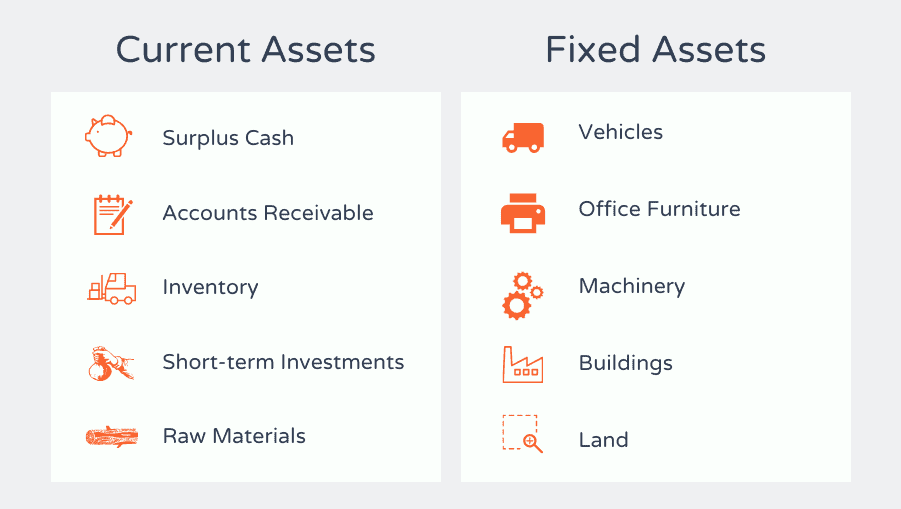
- Vehicles (cars, vans, delivery vehicles)
- Office furniture
- Machinery and equipment
- Buildings
- Land
A quick note on intangible assets
There are some types of intangible assets like trademarks or patents. These can still be treated as non-current assets because they can’t be easily and quickly converted into cash.
Track your assets in Brixx
Get started with our forecasting software so that you can plan your business' future
Start your free trial todayWhat are current assets?
Current assets are assets a business expects to use, sell, or convert into cash within one year. Current assets are often described as liquid assets, which means that they can be quickly turned into cash.
Common categories of current assets
The structure for current assets on the balance sheet is a little more universal than fixed assets, but will still change somewhat from industry to industry. Here are some common types:
Inventory
Products and materials at hand that are ready for sale or for producing goods.
Accounts receivable
Money customers owe the business for goods or services already delivered.
Cash (or surplus cash)
Cash held in bank or savings accounts, in-store tills, or other readily accessible places. This is the most liquid asset a business can have.
The difference between fixed and current assets
The key difference between fixed assets and current assets comes down to liquidity (how quickly something can be turned into cash).
- Fixed assets are long-term and usually take time to sell or cash out.
- Current assets are already cash or are expected to become cash within 12 months.
When you’re looking at a balance sheet and asking, “Which assets can help this business pay bills soon?” the answer is almost always the current assets.
Another key difference is depreciation
Fixed assets may be subject to depreciation, whereas current assets will never be subject to depreciation. This is because fixed assets typically lose value over time, for example cars will naturally depreciate over the course of their useful life. Current assets, on the other hand, are generally more short term (or are already cash) and won’t be affected by depreciation.
How should my assets be balanced?
There’s no perfect universal balance between fixed and current assets. The right mix depends heavily on:
- The industry
- The business model
- How the company generates revenue
- How quickly it collects cash
For example, a software-as-a-service business may not have many fixed assets because it sells digital products and doesn’t rely heavily on physical equipment. Meanwhile, a manufacturing business will likely have a much higher amount of fixed assets, such as machinery or facilities.
Can too many fixed assets be risky?
Even though fixed assets can represent long-term value, having most of your money tied up in them can create some cash flow problems.
If a business needs cash quickly (to pay staff, for example), it can’t easily ‘spend’ a building, or a machine. Selling assets takes time, and the business may not get a good price under pressure.
This is why so many investors will pay close attention to liquidity.
Using the current ratio to measure financial health
One of the most common ways to assess a business’ short-term resources is the current ratio.
The current ratio is a liquidity ratio that measures a business’ ability to pay short-term debts using its current assets.
It compares current assets to current liabilities (such as salaries).
Though a ‘good’ current ratio can vary from business to business, generally speaking:
- A lower current ratio may be seen as riskier
- A higher current ratio often signals stronger short-term financial stability
Analysts and investors will often compare the current ratio to similar businesses in the same industry, to better understand what ‘good’ looks like within the industry.
Current ratio formula:
Current ratio = Current assets / Current liabilities

Final summary
Lets summarise the key takeaways from the fixed vs current assets comparison:
- Fixed assets are long-term (non-liquid) assets that usually can’t be converted into cash within a year
- Current assets are short-term (liquid) assets that are already cash or are expected to become cash within one year
- The biggest difference between the two is liquidity, or how fast the asset can be turned into cash
- Fixed assets may depreciate over time, while current assets generally don’t
- The ideal mix of fixed and current assets depends on the business and industry
- Liquidity metrics like the current ratio help investors assess whether a business can cover short-term obligations
Understanding these assets makes it much easier to read a balance sheet and spot potential strengths or risks at a glance.
If you want clearer visibility on fixed assets vs current assets, sign up to Brixx to track assets and forecast your cash position with confidence.